From Data to Code
Bridging Generation and Training: A Systematic Review of Quality Issues in LLMs for Code
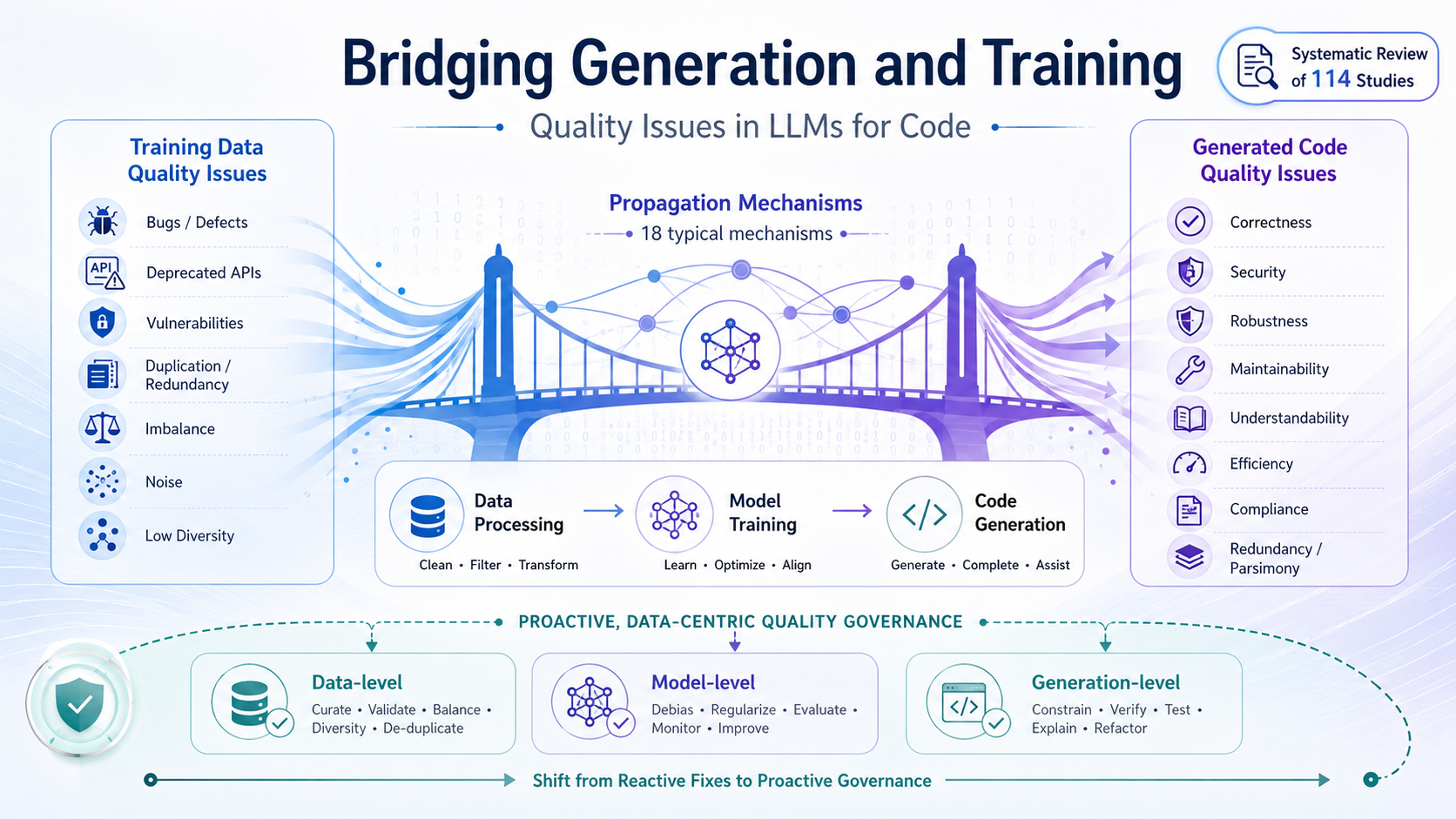
Trace the evidence connecting training-data quality with generated-code outcomes, and explore detection and mitigation across the LLM lifecycle.
About the review
Large language models frequently generate defective code, ranging from logical bugs to security vulnerabilities. Training-data quality contributes to these outcomes alongside model architecture, optimization and alignment, prompting and inference context, and decoding.
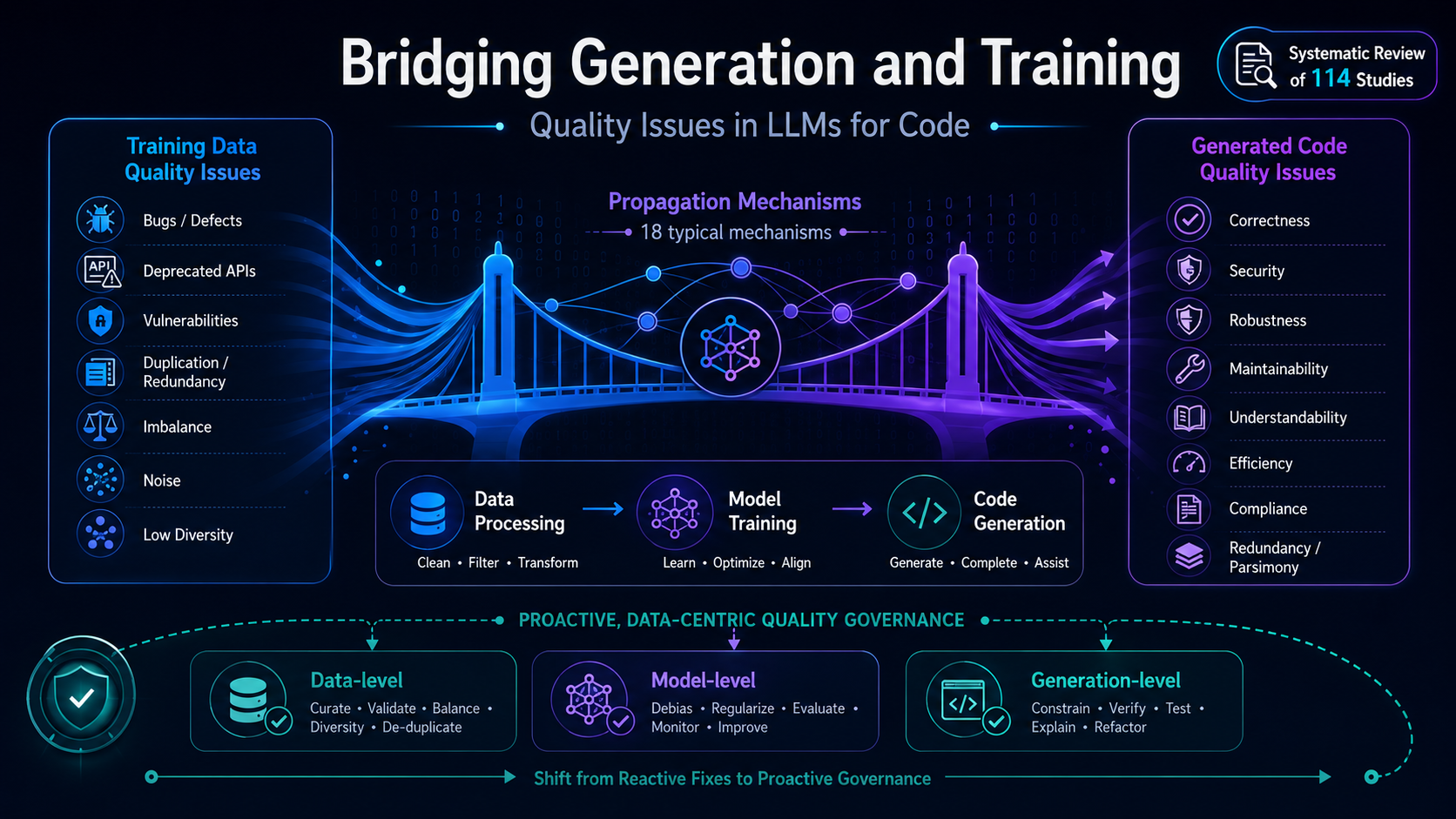
We review 114 included papers, synthesize eight generated-code quality dimensions and 13 training-data headings, and organize reported data-to-code relationships into 12 families. We also compare detection and mitigation methods by their prerequisites, outcomes, costs, and limitations. Data curation forms one layer of quality assurance coordinated with model, inference, and software-development controls.
The 101 paper-level relationship assignments from 67 papers describe literature coverage. Their counts and Sankey widths do not measure effect size or causal strength. Each assignment links to its supporting evidence and scope limitations.
Explore the findings
| Research question | Resource |
|---|---|
| RQ1: What generated-code quality issues occur? | Code quality taxonomy |
| RQ2: What training-data quality issues occur? | Training-data taxonomy |
| RQ3: What data-to-code relationships are reported? | Relationship families and evidence |
| RQ4: How are issues detected? | Detection methods and trade-offs |
| RQ5: How are issues mitigated? | Mitigation and practitioner workflow |
| How can the findings be checked? | Result data and reproduction guide |
Study collection
Database searches cover publications through December 31, 2025. After deduplication, 2,114 records yielded 122 eligible papers. Snowballing, completed in February 2026, added 12 candidates. Quality assessment retained 114 of 134 candidates at a consensus threshold of 10/16. Three independent pre-consensus total scores per candidate yield interval Krippendorff’s alpha = 0.717.
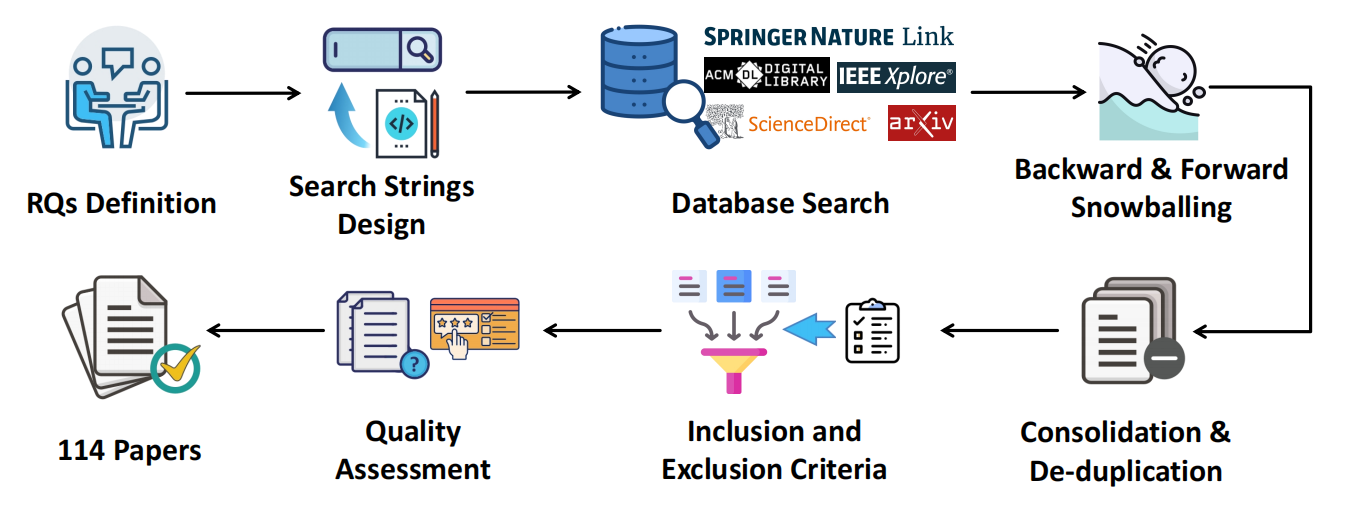
Paper collection and filtering. See the search summary and consensus scores.
Quality assurance across the lifecycle
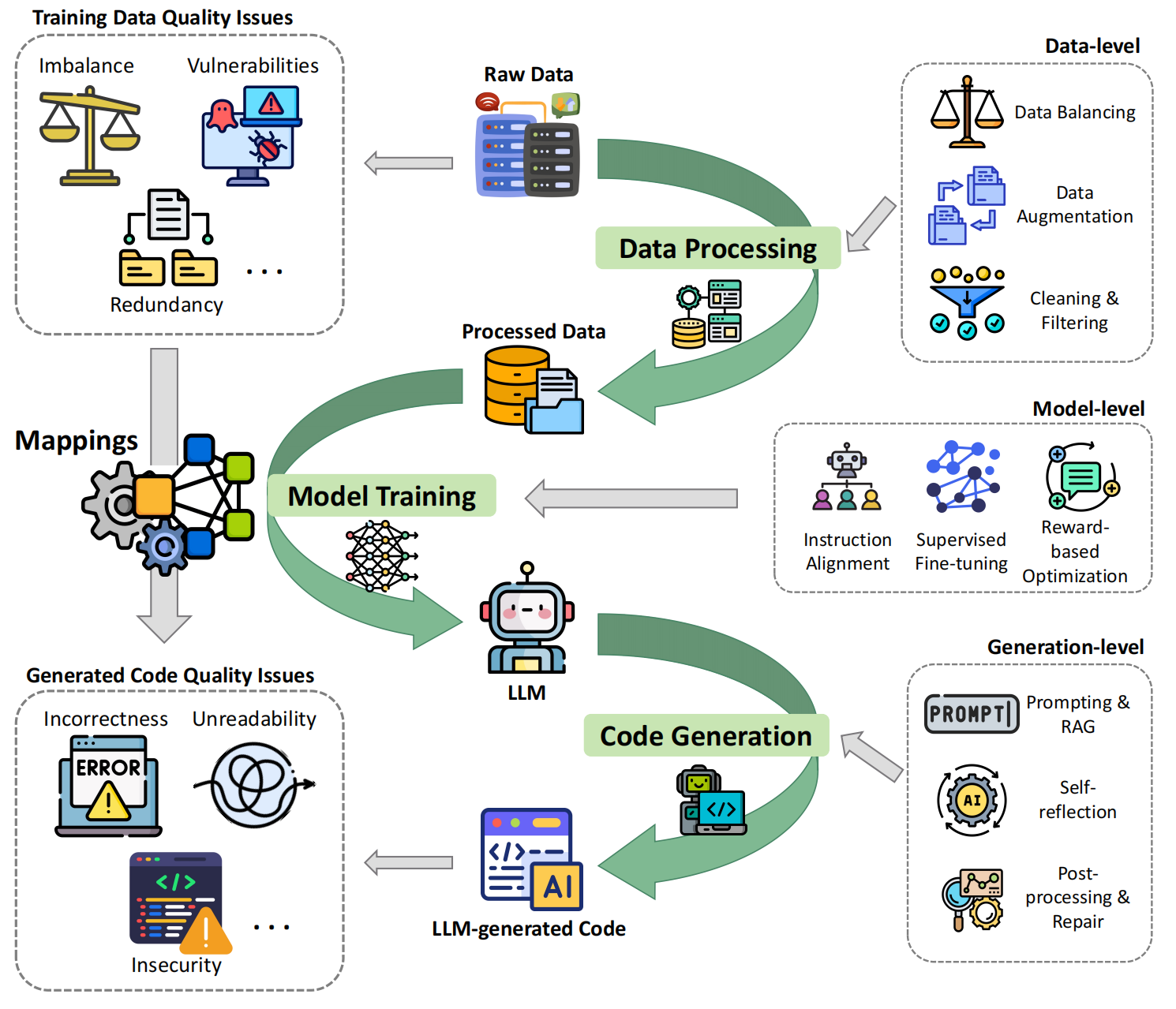
A lifecycle view of quality issues and interventions. Individual controls have been evaluated in different settings; the integrated workflow is an author synthesis.
Versions and contributions
This website and its result package reflect the major-revision synthesis. The May 2026 preprint and archived PDF document the original version; its taxonomy and mapping counts differ. Publication-status sensitivity results are a snapshot verified on August 29, 2026.
Contributions should identify the relevant research question, primary source, supporting passage, and scope limitation. Open an issue or a pull request in the project repository.